
Lower Starting Payments in a High-Rate Market: Is an Adjustable-Rate Mortgage (ARM) Right for You?
When mortgage rates climb, buying a home can feel like trying to hit a moving target. Every fractional increase pushes monthly payments higher, leading many prospective buyers to pause their home search.
However, more buyers are finding a path forward through a familiar loan option: the Adjustable-Rate Mortgage (ARM).
What Is an ARM and How Does It Work?
Unlike a standard fixed-rate mortgage where your interest rate remains identical for the full 30-year term, an ARM offers a hybrid structure:
Fixed Period: Your interest rate is locked at a lower initial rate for a set number of years.
Adjustment Period: After the initial period ends, your rate adjusts periodically up or down based on current financial market conditions.
The Financial Advantage
Because lenders take on less long-term interest rate risk with ARMs, they typically offer lower initial rates compared to fixed-rate loans.
The Rate Spread: Data from Bankrate shows ARM initial rates running more than a full percentage point lower than traditional 30-year fixed mortgages.
Monthly Savings: On a median-priced home, that single percentage point difference can translate to $150 to $300 in monthly savings.
Market Adoption: According to the Mortgage Bankers Association (MBA), roughly 1 in 10 mortgage applicants now select an ARM to maximize their purchasing power.
Understanding the 5/1 ARM Structure
One of the most common products on the market is the 5/1 ARM. Here is how to break down the numbers:
The "5": Your initial interest rate is fixed and guaranteed for the first 5 years.
The "1": Starting in year six, your rate adjusts once every 1 year (known as the rate "reset").
Important Protection: Interest Rate Caps
You don't have to worry about unlimited rate hikes. Today’s ARMs include rate caps that place legal limits on how much your rate can increase during a single adjustment period, as well as over the entire life of the loan.
Evaluating the Pros and Cons
An ARM isn't a one-size-fits-all solution. Consider how these factors align with your personal financial goals:
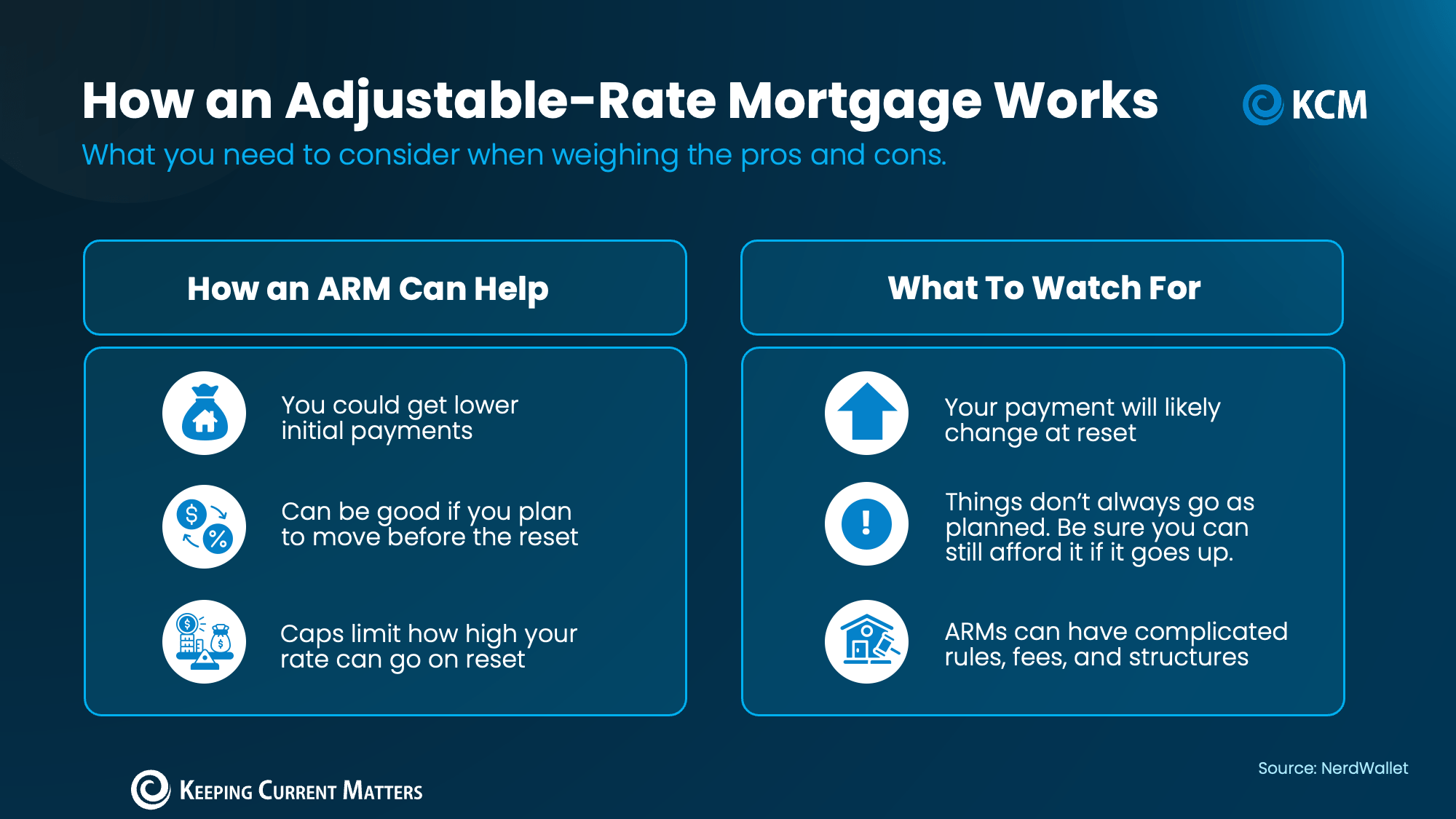
Key Advantages
Lower Initial Monthly Payment: Frees up monthly cash flow during your first few years of homeownership.
Ideal for Short-Term Ownership: If you plan to move or sell within 3 to 7 years, you enjoy the lower rate without experiencing the rate reset.
Potential for Rate Drops: If broader market rates decline, your mortgage rate could drop automatically without requiring a refinance.
Important Considerations
Future Rate Increases: Payments can increase after the initial fixed period ends.
Budget Flexibility Required: You must be financially prepared to absorb potential rate increases down the road.
Refinancing Dependencies: Qualifying for a refinance later depends on your future credit profile, income, and home equity.
What Happens When Your ARM Resets?
When your initial fixed period approaches its end, you have several strategic paths available:
Keep the Loan: Do nothing if the adjusted payment still comfortably fits your monthly budget.
Refinance to a Fixed-Rate Loan: Lock in a permanent rate if long-term predictability becomes your priority.
Refinance into a New ARM: Secure a brand-new introductory rate period.
Sell Your Home: Move to your next property before or at the time of adjustment.
Request Loan Modification: Speak with your loan servicer if you anticipate financial hardship.
Note: Refinancing requires qualifying for a brand-new loan. Keeping your credit score healthy and managing debt levels during your initial fixed period is essential.
Why Today’s ARMs Are Safer Than Pre-2008 Mortgages
ARMs earned a negative reputation following the 2008 housing crisis, but the regulatory landscape has changed dramatically.
Today's lending environment is governed by strict federal standards, primarily the Ability-to-Repay (ATR) Rule:
Rigorous Verification: Lenders are legally required to verify income, assets, and employment using official documentation (W-2s, tax returns, pay stubs).
Stress-Tested Approval: Lenders must qualify you based on the maximum potential rate you could face after a reset—not just the low introductory rate.
These protections ensure that borrowers who take out an ARM today are financially qualified to handle the loan long-term.
Bottom Line
In a high-rate market, an Adjustable-Rate Mortgage (ARM) can save you $150–$300+ per month upfront compared to a traditional fixed-rate loan.
It is a smart strategy if you plan to move, sell, or refinance within 5 to 7 years. Just be sure to work with a lender to model potential rate changes so you are financially prepared when the reset time arrives.
Interested in exploring your numbers? Reach out to a trusted loan officer to run custom scenarios and determine if an ARM fits your homeownership strategy.
